
Atchison County’s Three-Day View
The Atchison County Sheriff’s Office maintains a Released filter with newest and oldest ordering, first-or-last-name search, and a Show All choice. It is an official released-booking view, which is more useful than guessing from the Current roster. Still, the office does not advertise a rolling 72-hour list or a separate three-day URL.
The distinction matters. Three calendar dates are not necessarily 72 elapsed hours. At 6:00 p.m. Monday, a Friday release at 7:00 p.m. falls inside the interval, while a Friday release at 5:00 p.m. falls outside it. Date-only grouping would include both. The exact hour and minute shown on the booking card allow the correct comparison.
Check Atchison’s 72-Hour Releases
Set the interval before reviewing names. Atchison is in Central Time, so the current local timestamp must be the endpoint even if the search is being conducted elsewhere. A written cutoff also makes it possible to repeat the search or frame a precise request later.
- Open the official Released roster and sort the cards newest to oldest.
- Write down the present date and time in Atchison, then subtract exactly 72 hours.
- Include releases at or after the cutoff, and exclude releases even one minute before it.
- Continue through the visible cards until times fall before the cutoff; use name search if a known booking is missing.
- Compare the booking number, age, photograph, booking time, and charge context before treating a card as a match.
- If the list ends too soon or completeness matters, request the jail release log for the stated interval.
This is a wider review than the Atchison County 24-Hour Release List, which is aimed at same-day departures. It should not be described as an archive. The sheriff’s public website does not say how many days an ended booking remains accessible.
Fields in Atchison’s 72-Hour Review
Each card contains enough information to identify a booking and place its end inside or outside the calculated period. It does not explain the complete legal event.
| Roster field | Use in a three-day review |
|---|---|
| Release date and time | Controls whether the booking ended within 72 elapsed hours. |
| Name, age, and photograph | Help distinguish the intended person from a similar name. |
| Booking number | Provides the best reference for follow-up with the jail. |
| Booking date and time | Identifies the beginning of the displayed custody episode. |
| Charges | May point to a state sentence, warrant source, or court record that needs review. |
| Bond | Reports the amount associated with the booking, not the cause of release. |
| Profile | May add gender, race, and arresting agency to the public entry. |
The card does not label release reason, destination, releasing authority, surety, property disposition, or supervision office. “Released” should therefore be read as the end of the Atchison jail booking. It cannot alone establish dismissal, sentence completion, bond payment, or return to the community.
Repeated names need booking-level review across the whole span. A person can have more than one custody episode, and only the booking whose release timestamp falls inside the cutoff belongs in the calculated set. The booking number is the clearest reference for jail follow-up. Charge text may point toward a court or receiving agency, but it is not a substitute for the final disposition or movement record.
Atchison Weekend Release Coverage
A 72-hour interval is most helpful when routine checking was interrupted. A Monday search can reach back into Friday, and a post-holiday search can cover more than one missed day. That wider span reduces the chance that a release is overlooked merely because it did not happen on the date someone expected.
It does not remove processing uncertainty. The jail operates continuously, while the administrative hours posted by the sheriff are Monday through Friday, 8:00 a.m. to 5:00 p.m. Those office hours do not mean releases occur only during that period. No official daily release-time policy was found. A weekend movement may also take time to appear in another system. KASPER, for example, is updated on working days, so a county-to-state commitment late Friday may not appear there immediately.
Use the jail release timestamp for the physical end of the local booking and the court record for the legal order. If charge text indicates commitment to KDOC, check KASPER again after intake and the next working-day update rather than calling the roster disappearance a community release.
Holiday timing deserves the same care. The research found no Atchison policy that moves every scheduled release to the prior business day or the next one. Do not import a rule from another county. Calculate from the timestamp that actually appears, then contact the jail or court when a planned date and the recorded event do not agree.
Why Atchison Results Cross the Cutoff
The sheriff’s Released filter is dynamic. A live observation on July 18, 2026 displayed three bookings carrying July 17 timestamps, including one older than 24 elapsed hours. Cached official results at other moments exposed different counts and dates. This confirms that the roster changes, but it does not establish a precise update cycle or a fixed period of visibility.
The official Atchison Released roster illustrates the source used for both short windows:
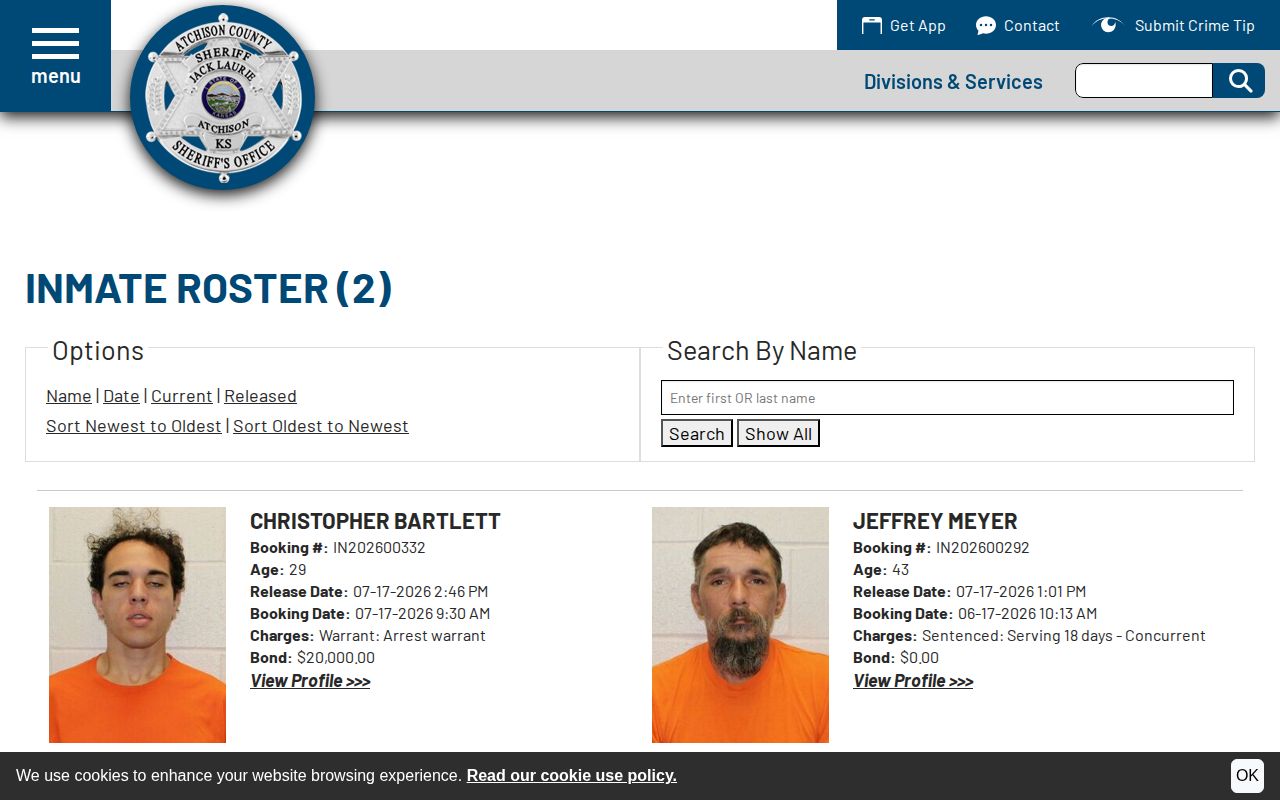
A short result set is not necessarily a complete 72-hour list, and an older card is not an error merely because it precedes the cutoff. Stop counting it for the requested interval, but do not infer the sheriff intended the page to have that boundary.
Where Atchison Releases Go Next
A community release may follow bond, recognizance, dismissal, completion of a county sentence, or a judge’s order. Other departures keep the person in custody. Transfer on an outside warrant, transport to another county, commitment to KDOC, federal custody, hospitalization, or another movement can all end the local booking.
The right next system depends on the event. A KDOC commitment belongs in KASPER. An out-of-county warrant points to the receiving county. Federal custody belongs in the Bureau of Prisons locator or the responsible federal agency. The district-court docket or journal entry can establish bond, dismissal, probation, sentence, or commitment, while a municipal warrant may belong with City of Atchison Municipal Court.
For a named-person investigation that must reconcile all those routes, use the Atchison County released-inmate lookup. The three-day page instead answers which visible local booking timestamps fall inside one defined 72-hour interval.
Recover an Incomplete Atchison Interval
If the visible feed ends before the calculated cutoff, the web roster cannot establish a complete three-day set. The durable route is a focused Kansas Open Records Act request to the sheriff. Identify the interval with both start and end timestamps and ask for the jail release log covering it.
- Call the 24-hour jail line at 913-804-6080 for current routing or clarification.
- Use the sheriff’s online KORA form and provide the person, approximate date, and booking number when known.
- Request release date and time, release or movement type, destination, and releasing authority or order reference.
- Ask for electronically available records in electronic form and seek a fee estimate before fulfillment.
- Check Kansas VINE for county-jail custody status, understanding that it is a notification system rather than a lasting archive.
- Review the proper court docket for the disposition or order that explains the physical release.
The sheriff form requires requester identity and contact information, a specific description, signature, and a K.S.A. 45-230 acknowledgment. It says the requester will be contacted for authorization if a fee applies, but it does not publish a flat release-record price. A precise 72-hour interval is more answerable than a request for every inmate record.
If the purpose is only to confirm one known departure, narrow the request to that booking and approximate release time. If the purpose is to reconstruct the entire interval, state the calculated cutoff and endpoint in Central Time. Asking for electronically available material in electronic form may reduce copying, while an advance estimate keeps an unknown research charge from becoming a surprise.
Verify Atchison Custody Status
A person still shown under Current is presented as remaining in Atchison County Jail. A person with a release timestamp under Released has left that particular booking. If the views conflict, preserve the number and times, call the jail, and seek the record. Do not resolve a lag by selecting whichever display supports a prior assumption.
Kansas VINE can independently report a participating county jail’s custody change and can support future notification. It does not cover KDOC state-prison residents. KASPER covers current, supervised, and discharged people sentenced to KDOC custody since 1980, but not an ordinary county-only booking. A court docket provides a more lasting legal narrative, though it may not show the exact minute someone crossed the jail threshold.
Note: Pair the jail timestamp with the court order or movement record when the difference between community release and transfer is important.
Public Record Search
Sponsored Results