
Atchison County VINELink Coverage
Kansas Victim Information and Notification Everyday, known as Kansas VINE, is reached through VINELink. The Kansas Attorney General describes it as free, confidential, voluntary, and open to the public. Atchison County Sheriff navigation links to VINE, making it the notification route for adults reported by the participating county jail.
The boundary is unusually sharp. Kansas VINE expressly excludes KDOC state-prison residents. For a person committed from Atchison County to a Kansas prison, use KASPER for custody and supervision status and KDOC Victim Services for state-system notification. Federal prison uses the BOP locator and its separate notification process. ICE has another locator. One VINE no-result cannot clear those systems.
Search an Atchison Inmate on VINELink
Use the direct Kansas interface and search for one known person. Names can match, so do not select a record from the name alone. Compare any identifier offered by the interface, the facility, and the custody details. The result reflects what the participating jail reported; it is not a court disposition.
- Open Kansas VINELink. Go to the direct state page and choose Find an Offender or Search.
- Enter the name. Add any identifier or filter the current interface offers.
- Review possible matches. Compare the displayed identity and make sure the facility is Atchison County Jail when that is the expected custodian.
- Open the correct record. Read custody status and location together.
- Register while the person is in custody. Choose the notify action if a future status change is the goal.
- Verify a released result. Check the sheriff release record or the court order to learn what kind of custody change occurred.
If the person cannot be found, first check spelling and name variants. Then question the custody assumption. A state-prison commitment belongs in KASPER, while a federal case may belong in the BOP locator. The Atchison County release search gives the broader system-by-system route.
Atchison VINELink Release Fields
The exact interface can change, and fields depend on what the jail supplies. Kansas materials support a name or identifier search, custody status or location where supplied, and a register or notify action. A released or out-of-custody status confirms that the reporting jail sent a custody exit or change. It does not establish bond, dismissal, transfer, sentence completion, or destination.
| Field or control | What it means |
|---|---|
| Jurisdiction | Kansas is the selected VINE network. |
| Name or identifier | Search input used to narrow a specific match. |
| Facility or location | The reporting county jail or supplied custody location. |
| Custody status | The current status reported to VINE, subject to update lag. |
| Released/out of custody | A reported exit or change from that jail, not proof of community destination. |
| Register/notify | Prospective enrollment for later status changes. |
Unlike KASPER, Kansas VINE is not the source for a KDOC Anticipated release date, sentence structure, supervision office, or state discharge. Court orders answer why a county case ended. The sheriff’s exact release timestamp answers when the Atchison booking was marked released.
Register Atchison Release Notifications
Enrollment is prospective. Find the person while the Atchison County Jail record is active, then select the registration option on that matched record. Do not assume a new alert can be created after release. The current screen governs which delivery methods are offered.
- Open the matched in-custody record. Recheck the person and facility before sharing contact details.
- Select register or notify. Choose the status-change notification action.
- Pick an offered channel. Kansas materials describe telephone, text, email, TTY, or app options, though the live menu may vary.
- Enter and confirm the destination. Check each digit or address because an error can prevent notice.
- Create the voice PIN. Kansas’s official guide uses a four-digit PIN for telephone alerts; email does not use that PIN.
- Finish confirmation. Save any confirmation that the interface provides.
- Acknowledge a voice call. Listen, then enter the PIN followed by the pound sign to stop repeat calls.
Email is described as a single message for a status change. Voice calls may repeat until acknowledged. A notice is a prompt to check the agency source. It does not replace a release report, movement log, or court entry.
Atchison VINELink Limits
VINELink data can lag a real custody event. The service reports a status change supplied by a participating jail, and a no-result can reflect spelling, timing, transfer, or the wrong custody system. For an urgent live question, contact the custodian. For durable proof, request the originating record.
A released status does not identify destination. Someone may have bonded out, received recognizance, completed a county term, transferred on a warrant, entered KDOC custody, or moved to another agency. Compare the sheriff Released roster, which includes an exact timestamp, and obtain the release report when the distinction matters. The court docket can explain a dismissal, sentence, probation order, or commitment.
Federal BOP prisoners are outside Kansas VINE. ICE civil custody also uses a separate federal locator, and neither system should be inferred from an Atchison roster disappearance. A KDOC state prisoner belongs in KASPER even when the conviction began in Atchison County.
Kansas Splits Atchison Release Alerts
Atchison County’s local VINE link and the state Attorney General page lead to a county-jail network. KDOC maintains a separate victim-notification registration form for people in a state facility or under KDOC supervision. That split should guide the search from the start. The arrest county does not determine which alert system holds the current record.
If an Atchison jail charge indicates commitment to KDOC, allow for intake processing and switch to KASPER. That repository is updated each working day and includes state prisoners, people on post-incarceration supervision, and discharged people sentenced to KDOC custody since 1980. It can show status, location, supervision office, movements, and the Anticipated release date.
KDOC notification registration is not a substitute for the ordinary county-jail VINE alert. The two systems have different custodians and coverage. Choosing the one that matches current custody reduces false no-results and missed notices.
Atchison VINE Phone Number Caution
Current official Kansas sources print two different voice numbers. The Attorney General webpage shows 1-866-574-7463. The official guide and a newer state announcement show 1-866-574-8463, which matches the KS-4-VINE mnemonic. The guide also lists TTY 1-866-847-1298. Because the state sources conflict, the safest route is the direct Kansas online interface until the state resolves the discrepancy.
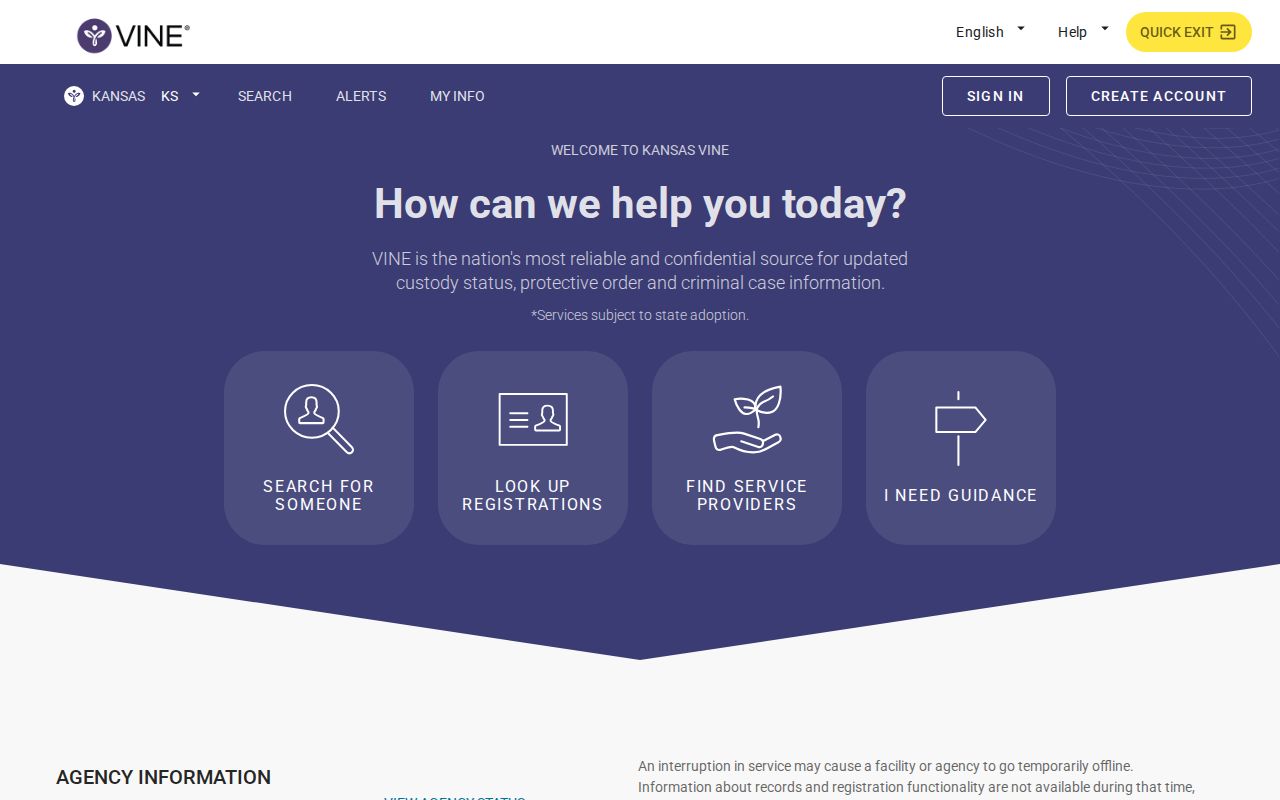
The direct Kansas VINELink page is the source for the live search and options. Its successful manifest image appears below with no personal record displayed.
Operators may be able to help in many languages, according to the Attorney General. Still, the jail or court record is needed when the question is not merely status, but the legal reason for release or the next custodian.
Verify an Atchison Release Alert
Record the time and wording of the alert. Then open the Atchison sheriff Released view and compare the correct booking. Its cards can show a photo, displayed name, booking number, age, booking time, exact release time, charges, bond, and profile link. Those details help match the right event.
Next, ask what must be proven. The sheriff release record can document the booking’s end. A movement record can identify transfer. The court journal entry can show bond, dismissal, probation, sentence, or commitment. KASPER can confirm later KDOC intake or supervision. Each source answers a different part of the event.
Keep notification contact information current and do not rely on one channel for an urgent matter. Automated services can face delay, incorrect input, or changing interfaces. Direct agency confirmation remains the final step.
Record an Atchison Custody Change
Save the booking number and relevant time before requesting proof. Ask the sheriff for the release report, release authorization, jail log, or movement record tied to that booking. A narrow request helps the custodian locate the event and separates the public release facts from other material that may be restricted.
If the case was filed in Atchison County District Court, the docket and journal entry can show bond changes, dismissal, sentence, probation, or commitment. A city warrant may instead lead to Atchison Municipal Court. The alert identifies a custody change; the correct court record explains the legal action behind it.
The Kansas registered-offender search is also a separate source. It applies only to people who have a statutory registration duty and is neither a VINE release list nor proof of a release date. A registry match may continue after custody, while many released people will have no registry entry. Use it only for its stated registration purpose.
For a state-system movement, KASPER may preserve a discharged record long after a county screen has changed. For a federal sentence, the BOP locator can report a released status and date when available. These routes are fallbacks for their own custodians, not add-ons that expand Kansas VINE coverage.
Notification enrollment should also protect accuracy. Register from the matched record, verify the phone number or address, and keep the four-digit voice PIN available to the intended recipient. A wrong digit can prevent delivery, while failure to acknowledge a call may cause repeats. If the person’s facility changes, confirm whether the existing registration follows that change or whether the live interface requires a new enrollment. Kansas guidance supports the basic process, but the options visible at registration time control.
Do not read silence as proof of continued custody. A delayed feed, expired contact method, transfer beyond county VINE coverage, or failed confirmation can all interrupt notice. Check the source directly when timing matters.
Public Record Search
Sponsored Results